Russia and Thailand: Trade, Investment and Logistics...
read more
Russian Logistics Expert: — What happened in the fuel market on March 26?
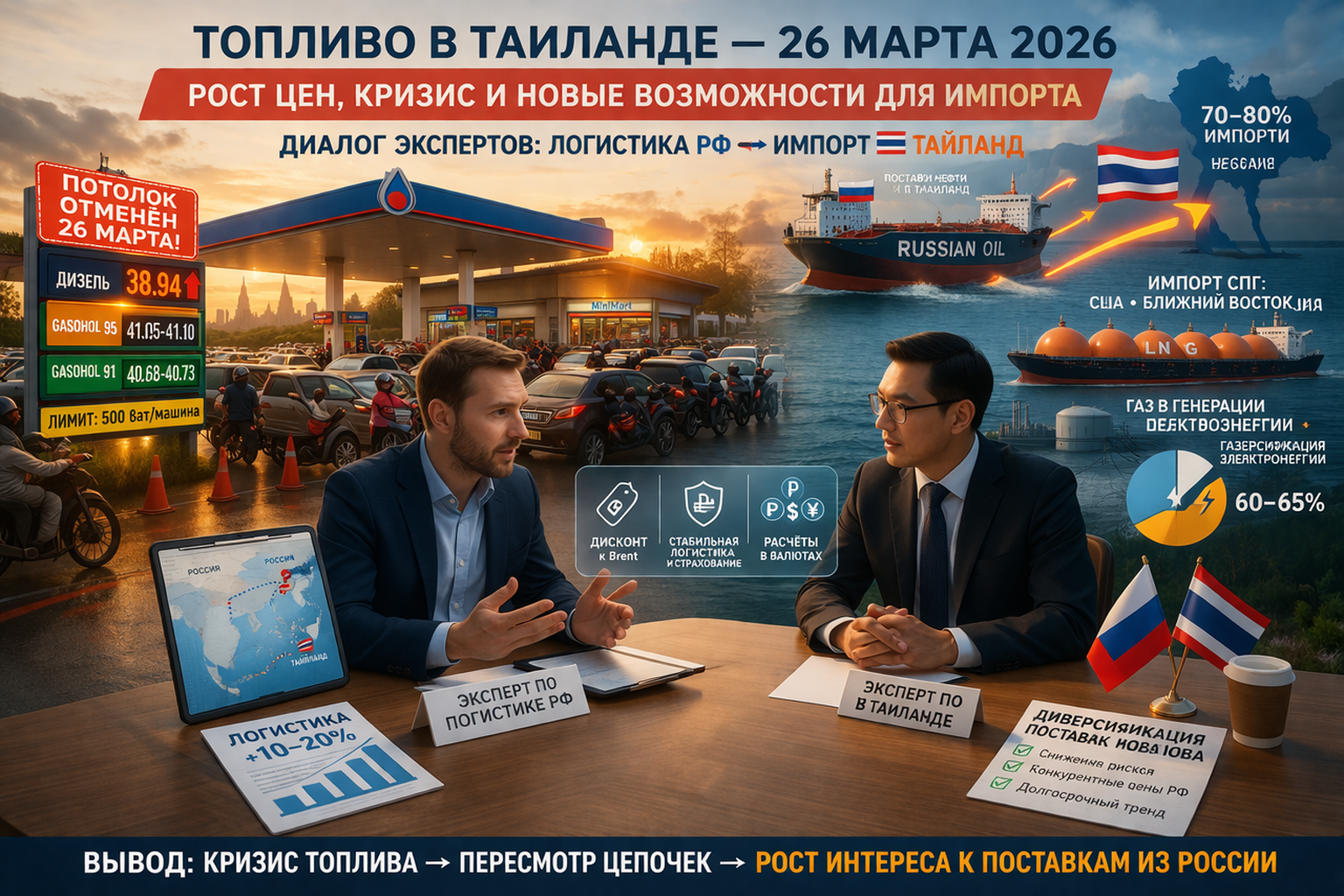
Thailand Import Expert: On March 26, the diesel price cap was lifted (from 33 to 38.94 baht/liter), leading to an increase of about 6 baht across all fuel types. The decision was announced by Prime Minister Anutin on March 23 amid a crisis in the oil fund. This effectively marks a transition to market-based pricing [Thaipost].
Russian Logistics Expert: — What are the current prices and how does this affect the market?
Thailand Import Expert: Diesel reached 38.94 baht/liter, Gasohol 95 — 41.05–41.10 baht/liter, Gasohol 91 — 40.68–40.73 baht/liter, representing a sharp increase. For businesses, this means an immediate 10–20% rise in logistics costs, especially impacting imports and domestic transportation [EPPO].
Russian Logistics Expert: — Have opportunities for Russian oil supplies increased? What are the criteria now?
Thailand Import Expert: Potentially yes, as Thailand heavily depends on imports: about 70–80% of oil is imported. With high global prices, countries are diversifying suppliers, and Russia is being considered. Key criteria include pricing (discount to Brent), logistics stability, cargo insurance, alternative payment currencies, and compliance with international regulations.
Russian Logistics Expert: — What is happening at gas stations and how long will the crisis last?
Thailand Import Expert: Long queues at gas stations have already been observed, along with limits of up to 500 baht per vehicle. The crisis may last several months due to both the domestic oil fund deficit (35 billion baht) and high global oil prices (~$242/barrel). Stabilization without subsidies will be difficult [Thaipost].
Russian Logistics Expert: — What about gas supply in Thailand?
Thailand Import Expert: The situation is similar: Thailand increasingly depends on LNG imports due to declining domestic production. The country is actively expanding LNG imports from sources such as the US and the Middle East. Gas accounts for about 60–65% of electricity generation, making it critical for the economy.
Russian Logistics Expert: — How does this compare to Russia?
Thailand Import Expert: In Russia, gasoline AI-95 costs about 55 rubles (~18 baht/liter), and diesel about 60 rubles (~20 baht/liter), nearly half the Thai price. This makes logistics significantly more expensive in Thailand, increasing overall supply chain costs.
Russian Logistics Expert: — Should businesses reconsider supply chains now?
Thailand Import Expert: Yes, this is a key moment. Rising fuel prices are forcing companies to diversify supply chains to reduce risks and dependency on expensive logistics routes.
Russian Logistics Expert: — Is it worth switching to Russian suppliers?
Thailand Import Expert: It is becoming increasingly relevant. Russia offers competitive pricing on energy, raw materials, and industrial goods, helping offset rising logistics costs. Many Southeast Asian countries are already adjusting procurement strategies.
Russian Logistics Expert: — Is this temporary or long-term?
Thailand Import Expert: This is a long-term trend. The crisis exposed vulnerabilities in single-source supply chains, making diversification the new standard even after stabilization.